Losing photos from your computer is not just a technical problem – it is an emotional one. Whether those images belong to your family, your work, or your personal projects, deleting them by mistake can instantly create panic.
The good news is simple and honest:
In many real-world situations, deleted photos can still be recovered from a PC – if you act correctly and quickly.
This guide is written for normal users, not engineers.
First – understand what really happens when a photo is deleted
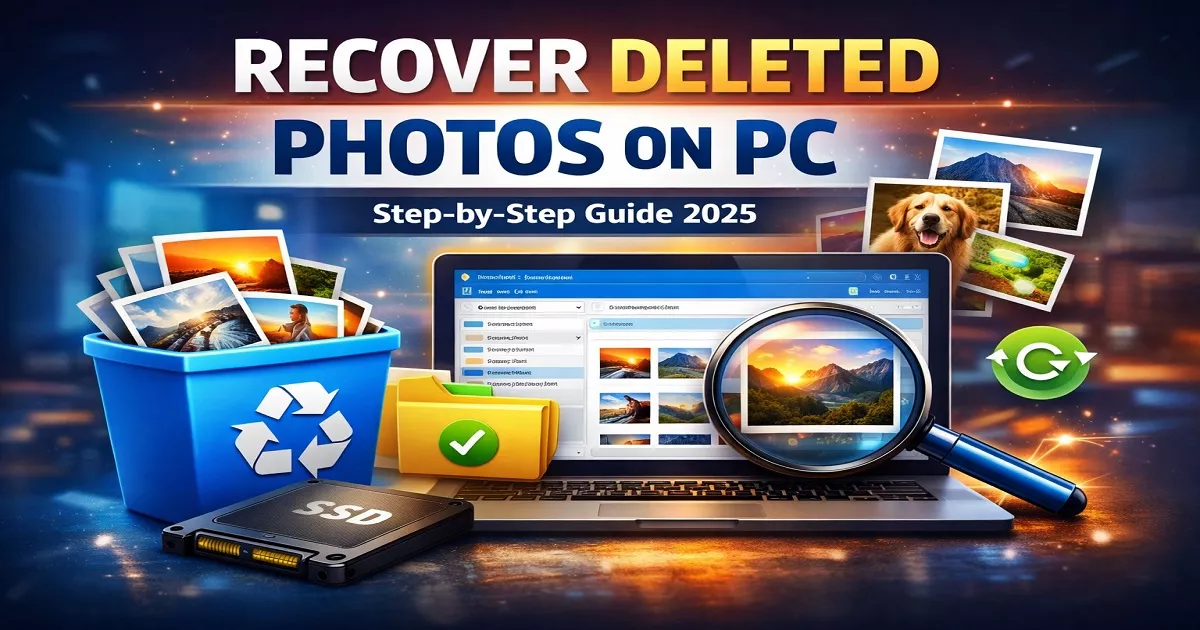
When you delete a photo in Windows, the file is not immediately destroyed.
Windows only removes its index entry and marks that storage space as free. The photo still exists physically on your drive until new data replaces it.
That is why one rule matters more than anything else:
Stop using the drive as soon as you realise photos are deleted.
Avoid:
- installing new programs
- downloading files
- copying large folders
- updating heavy software
Every new write operation can permanently overwrite your lost photos.
Before you start recovery – make your system stable
If your PC is unstable, freezing, or showing system errors, fix that first.
A crashing system can interrupt scans and corrupt recovery attempts.
If you are already facing system problems, you may find this helpful:
How to fix Windows Blue Screen – 5 quick solutions
A stable system significantly improves your chances of a clean and successful scan.
Step 1 – Check the Recycle Bin first (always)
This sounds obvious, but many users skip it.
Open your Recycle Bin and search by file type:
- .jpg
- .jpeg
- .png
- .heic
- .raw
If you find your photos:
Right-click → Restore
Your photos will return to their original folder.
This works only when:
- you did not use Shift + Delete
- the Recycle Bin was not emptied
Step 2 – Recover photos using Windows File History
If you previously enabled File History, Windows automatically keeps copies of your important folders such as Pictures and Desktop.
To restore:
- Open the folder where the photo was originally stored
- Right-click inside the folder
- Click Restore previous versions
- Open an older version and copy your photos back
You can also learn more about File History directly from Microsoft support page
Step 3 – Restore photos using “Previous Versions”
Even if you never configured File History manually, Windows may still create snapshots when system protection is enabled.
This method is very helpful when:
- a folder was cleaned
- multiple photos were removed at once
Simply:
- Right-click the original folder
- Click Properties
- Open the Previous Versions tab
- Select a version created before deletion
- Open and copy the photos
Step 4 – Restore photos from Windows Backup
If you use Windows Backup (Backup and Restore – Windows 7 style), this is one of the safest ways to get your photos back.
Open:
Control Panel → Backup and Restore → Restore my files
Browse your backed-up photo folders and restore them.
This is clean recovery because it does not touch the deleted data area at all.
Step 5 – Recover permanently deleted photos using recovery software
If:
- you used Shift + Delete
- the Recycle Bin is empty
- backups are not available
Then you must use professional data recovery software.
These tools scan your drive at a low level and look for known image file signatures.
Important safety rule
Never install recovery software on the same drive where your photos were deleted.
Always use:
- another internal drive, or
- an external USB drive
Typical recovery workflow
- Launch the recovery tool
- Select the drive where photos were deleted
- Run a deep scan
- Filter by photo file formats
- Preview found images
- Recover them to another storage location
If your photos were deleted from a USB stick or memory card, you should also read this related guide:
How to recover deleted files from flash drive in Windows 11
The scanning logic and safety rules are very similar.
Recovering photos from SD cards, USB drives and external hard drives
When photos are stored on removable media, follow these rules carefully:
- stop using the device immediately
- do not format it again
- remove the card safely
- use a card reader instead of connecting the camera directly
Most modern recovery tools can scan:
- SD and microSD cards
- USB flash drives
- portable hard drives
Special case – recovering photos from SSD drives
If your PC uses an SSD, recovery becomes more complicated.
Modern SSDs use a technology called TRIM.
When TRIM is active, deleted data blocks may be cleared automatically.
This reduces recovery success significantly.
You can read Microsoft’s technical explanation here
In simple words:
If your photos were permanently deleted from an SSD and the system has already processed TRIM, recovery may not be possible.
That is why acting immediately is extremely important on SSD-based PCs.
Why some deleted photos cannot be recovered
Even the best tools cannot recover photos when:
- the storage blocks were overwritten
- TRIM cleared the blocks on SSDs
- the drive was securely wiped
- the device has physical damage
This is not software failure – it is how storage technology works.
Common mistakes that reduce recovery chances
Avoid these mistakes at all costs:
- installing recovery software on the same drive
- running multiple scanners again and again
- continuing heavy downloads after deletion
- formatting the drive before scanning
All of these increase the chance of permanent overwrite.
Professional tip – how experts improve recovery results
Data recovery professionals follow two strict principles:
- never write new data to the affected drive
- always recover files to a different storage device
You should follow the same approach at home.
Real-world value tip – check your system and devices after recovery
After you recover your photos, it is a good practice to make sure your system and connected devices are working correctly.
If you use printers, scanners or external devices frequently, keeping drivers updated helps prevent system-level file handling errors.
For example, you can refer to:
How to install Intel wireless Bluetooth driver in Windows 10
And if you use printers at home or in an office:
How to add Canon printer to laptop – step-by-step guide
Recovering photos is only half the job – protecting them is the real solution
Once your photos are safe again, take a few minutes to prevent future loss.
Enable automatic backups
Use:
- Windows File History
- external backup drives
- or cloud backup services
Follow the simple 3-2-1 backup rule
- keep 3 copies of your photos
- store them on 2 different devices
- keep 1 copy off-site or in the cloud
Useful productivity tip after recovery
Many users recover their photos and later start editing or organizing them.
If you are new to editing and want something simple and lightweight, you may find this useful:
Which is the best video editor for beginners
This can help you manage recovered media files efficiently.
If your system fails to boot after storage or system errors
In rare situations, users experience boot problems after storage failures.
If you ever face that situation, this guide can help:
How do I fix a boot device not found error
Device maintenance also matters
Peripheral problems and outdated utility firmware can sometimes create driver and communication issues during backups and transfers.
If you use Epson printers, you may also want to keep this reference:
Epson L3250 ink pad reset guide
And for older but widely used printers:
HP LaserJet M1005 MFP driver for Windows 10 download
Frequently Asked Questions
1. Can I really recover deleted photos from my PC?
Yes.
In most cases, deleted photos can be recovered if the storage space has not been overwritten and you act quickly.
Your chances are higher if you first check the Recycle Bin or restore from Windows backup options before using any recovery software.
2. Can I recover photos after emptying the Recycle Bin?
Yes, it is still possible.
However, you will need to use a professional data recovery tool or restore the photos from a backup if available.
Once the Recycle Bin is emptied, Windows no longer keeps a simple reference to those files.
3. Is it safe to use photo recovery software on my PC?
Yes, it is safe if you follow one important rule:
Do not install the recovery software on the same drive where your photos were deleted.
Always recover files to a different drive or an external storage device.
4. Can permanently deleted photos be recovered from an SSD?
In many cases, recovery from SSD drives is difficult because of a technology called TRIM.
If TRIM has already cleared the deleted blocks, the photos may not be recoverable.
That is why you should stop using the PC immediately and try scanning as soon as possible.
5. Can I recover deleted photos without any software?
Yes, but only in these situations:
- The photos are still in the Recycle Bin
- File History or Previous Versions are available
- You have a Windows backup
If none of these options exist, third-party recovery software is required.
Final thoughts – a realistic conclusion
Recovering deleted photos on a PC is absolutely possible in many situations.
But success depends on three real factors:
- how quickly you stop using the drive
- whether the storage space has been overwritten
- and which recovery method you use first
Always try recovery in this order:
- Recycle Bin
- File History or Previous Versions
- Windows Backup
- Professional recovery software
The most important message to remember is very simple:
Do not continue using the drive after deletion.
If you follow the steps explained in this guide carefully and patiently, you give yourself the best possible chance to bring your lost photos back safely.
Disclaimer: This article is written for educational purposes. Recovery results may vary depending on storage type, system configuration and overwrite conditions.